01 — Definition
What, exactly, is dark energy?
Throw a ball into the air and you know what happens next: gravity slows it, stops it, brings it back. For most of the twentieth century, cosmologists assumed the universe worked the same way. Space has been expanding since the Big Bang, and every galaxy pulls on every other, so the expansion must be slowing — the only question worth asking seemed to be by how much. In 1998, two rival teams set out to measure that slowing. Both found, to their disbelief, the opposite. The ball is not falling back. It is accelerating upward, faster every moment, as though something were pushing.
That something is what we call dark energy — and the name is an honest confession of ignorance. It is not a substance in any familiar sense. It does not clump, does not glow, does not dilute as space expands the way matter does. It behaves instead like an energy of space itself: every cubic metre of vacuum, everywhere, appearing to carry the same tiny, built-in push. Because the universe is mostly empty space, that faint per-metre push adds up to the dominant ingredient of the cosmos — roughly sixty-eight percent of the total energy of everything, outweighing all matter, dark and ordinary combined.
It is worth being precise about what dark energy is not. It is not dark matter, despite the sibling name — dark matter pulls things together and builds galaxies, while dark energy pushes the universe apart and builds nothing. And it is not a force acting on objects through space; it is a property of space, revealed only on the grandest scales, where enough empty volume accumulates for the push to beat gravity's pull. Within galaxies, solar systems and atoms, gravity and the other forces win effortlessly. Dark energy rules only the emptiness — but the universe is almost entirely emptiness.
"We spent the twentieth century learning what the universe is made of. The twenty-first opened with the discovery that we had missed most of it — and that the missing part is pushing."
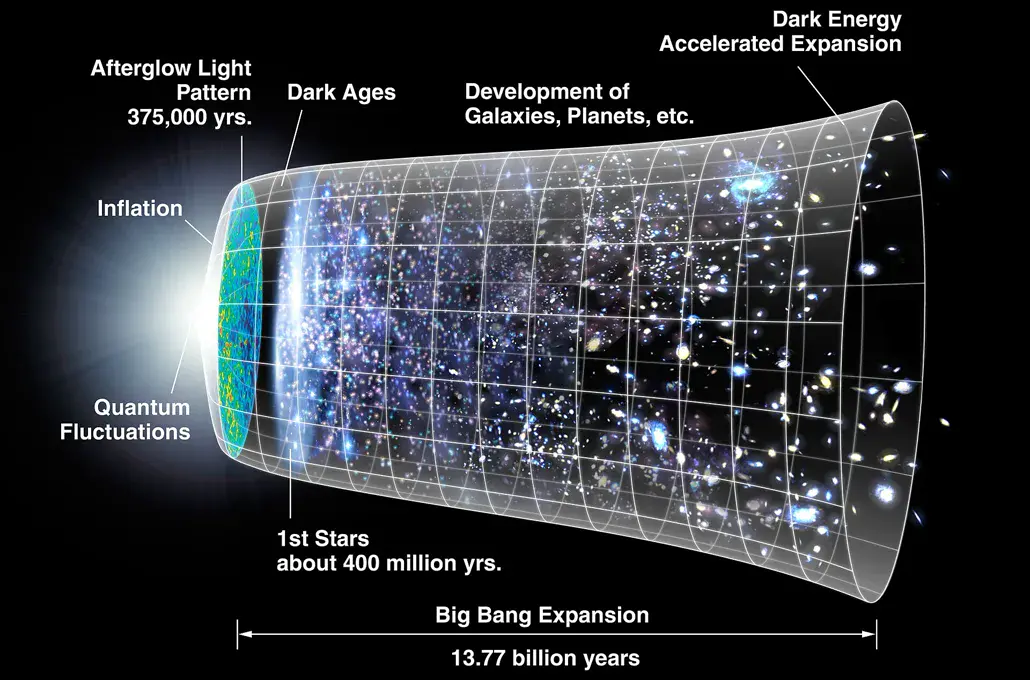
How to read the flare
Time runs left to right: the Big Bang, the afterglow light of the microwave background, the dark ages, and then galaxies. Watch the outline. For the first nine billion years the widening visibly slows — gravity applying the brakes to the expansion.
Then, around five billion years ago, the profile begins to widen faster again. That gentle trumpet-bell flare is dark energy overtaking matter — the moment the universe changed gear.
02 — The discovery
Two teams, one impossible answer
To measure how the expansion has changed over time you need two things for very distant objects: how fast they are receding, which their reddened light tells you directly, and how far away they are, which is far harder. The 1990s teams used the best distance markers ever found: Type Ia supernovae, exploding white dwarf stars that all detonate at nearly the same intrinsic brightness. Find one in a distant galaxy, compare how bright it looks with how bright it truly is, and you have the distance — a "standard candle" visible more than halfway across the observable universe.
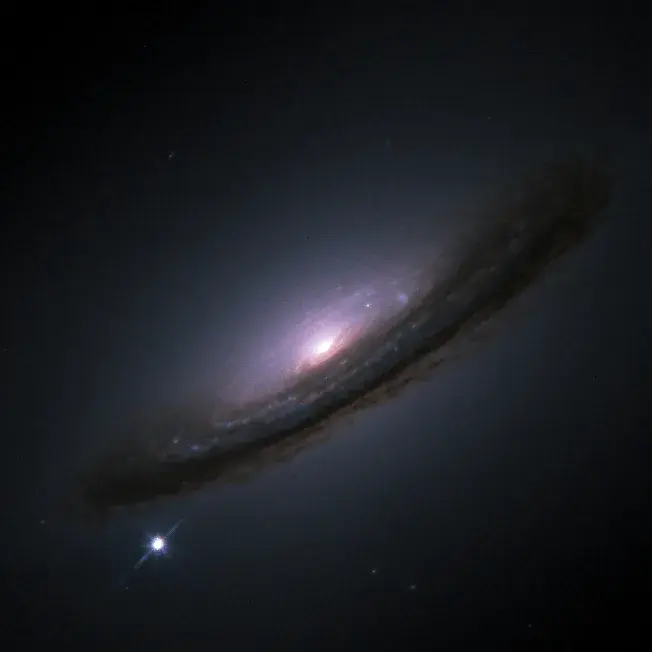
The candle in the dark
The High-Z Supernova Search Team and the Supernova Cosmology Project raced each other through the decade, expecting to crown their careers by measuring how much gravity was braking the cosmos.
Instead, both found the distant supernovae consistently fainter — further away — than any decelerating universe allows. The expansion had been speeding up for billions of years. Two independent teams, two datasets, one impossible answer arriving simultaneously: that redundancy is why the world believed it almost at once.
The result was announced in 1998, confirmed relentlessly ever since, and honoured with the 2011 Nobel Prize in Physics. It stands among the greatest upsets in the history of science — not because anyone doubted the data for long, but because of what it implied: the dominant component of the universe had gone completely unnoticed until the last years of the twentieth century.
03 — The case
The anatomy of the evidence
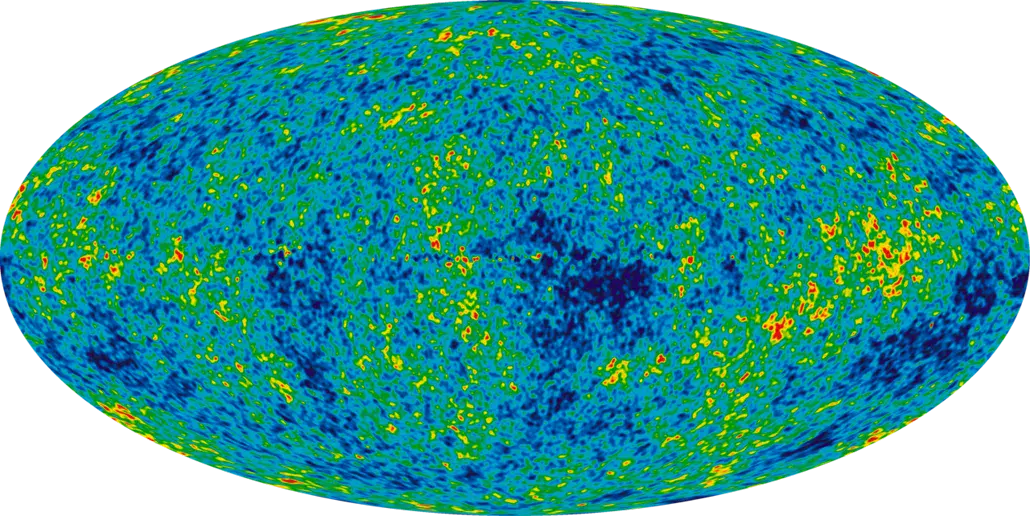
Extraordinary claims demand more than one line of proof, and dark energy now rests on several that are entirely independent of each other — different physics, different instruments, different possible mistakes, all pointing to the same two-thirds slice of the cosmic budget:
04 — The suspects
What could it possibly be?
Knowing precisely how much dark energy there is has proved far easier than knowing what it is. The candidates fall into three broad families, and telling them apart hinges on one measurable question: is the push truly constant through cosmic time, or does it evolve?
The cosmological constant
Einstein's Λ: a fixed energy of the vacuum itself, unchanging everywhere and forever. It fits every observation so far — but naive quantum theory predicts its value should be ~10120 times larger, the worst prediction in physics.
Quintessence
A dynamic energy field filling space — like an ultralight cousin of the Higgs — whose push can strengthen or fade over cosmic time. If dark energy is found to evolve even slightly, some field like this becomes the prime suspect.
Modified gravity
Perhaps nothing fills space at all, and Einstein's equations simply need correcting over billion-light-year distances. No modification yet proposed passes every test the standard picture passes — but the door is not closed.
05 — The measurement
Weighing the whole sky
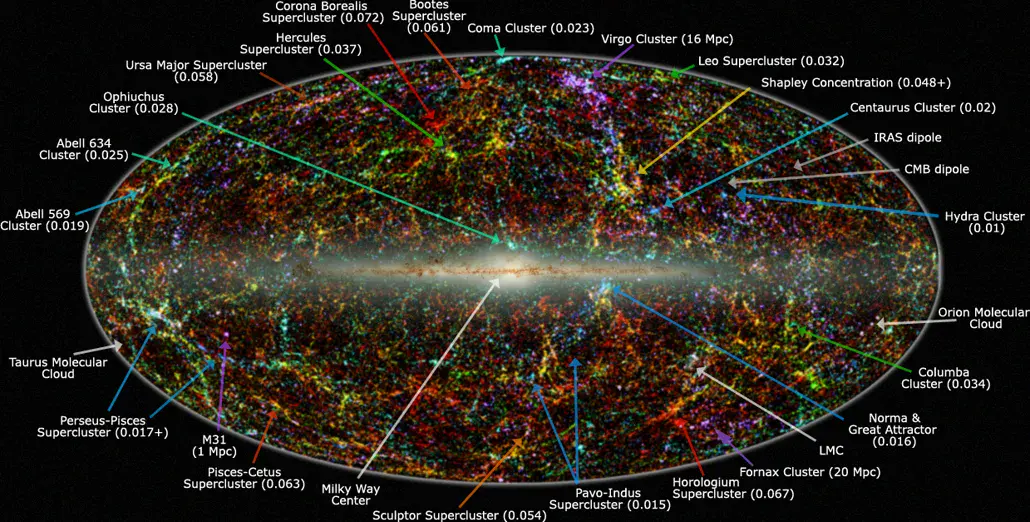
Because dark energy reveals itself only across enormous volumes, studying it means mapping the universe wholesale. The current generation of instruments — DESI measuring tens of millions of galaxy positions, ESA's Euclid imaging a third of the sky, and the Vera Rubin Observatory soon cataloguing billions of objects — are all, at heart, dark-energy machines: their maps chart how fast space has stretched and how structure has grown through thirteen billion years.
A ruler in every direction
Surveys like this are not photographs so much as measuring instruments. Buried in the statistics of a million galaxy positions is the frozen sound-wave ruler of the early universe — and reading that ruler at every distance turns the whole sky into a history of the expansion.
Two speeds for one universe
Measuring today's expansion rate from the nearby universe gives a value stubbornly higher than the one predicted from the early universe. The gap refuses to dissolve as measurements improve — and dark energy's behaviour is a leading suspect in the mismatch.
The first crack in Λ?
Recent DESI results have hinted — no more than hinted, so far — that dark energy may be weakening slightly over time. If that firms up with more data, the cosmological constant falls, quintessence rises, and cosmology has its biggest news since 1998.
06 — Endings
The fate of everything
Whatever dark energy turns out to be, it now steers the future of the universe. The endings on offer differ only in what the push does next — and for the first time in history, which obituary the cosmos gets is an experimental question:
The Big Freeze
If the push stays constant, expansion runs away gently but forever. Distant galaxies slip beyond view, star formation gutters out over trillions of years, and the universe ends not with a bang but an ever colder, ever emptier quiet. The current favourite.
The Big Rip
If the push strengthens with time, it eventually overwhelms every bond: clusters, galaxies, solar systems, planets and finally atoms are torn apart in a last cascading instant. Current data disfavour it — but cannot yet rule it out.
The Big Crunch
If dark energy fades or flips sign, gravity retakes command and the expansion reverses into collapse — the Big Bang run backward. The recent hints of weakening dark energy have quietly reopened this old door.
07 — History
A short history of a persistent idea
- 1917
Λ is born
Einstein adds a "cosmological constant" to his equations — a repulsive term invented purely to hold the universe static, as everyone then assumed it must be.
- 1929
The universe expands
Hubble's galaxy measurements reveal the expansion, removing the constant's original purpose. Einstein reportedly calls Λ his "biggest blunder" and strikes it out.
- 1980s
A budget that won't balance
Inflation theory and early data favour a flat universe, yet all the matter found — dark included — falls far short of flatness. A few theorists quietly suggest resurrecting Λ to fill the gap.
- 1998
The impossible result
Two competing supernova teams independently find the expansion accelerating. Einstein's discarded term returns — no longer a blunder, but the dominant ingredient of the cosmos.
- 2003
Precision cosmology
WMAP's map of the microwave background nails the cosmic recipe: roughly one-third matter, two-thirds dark energy — a split later sharpened by the Planck mission.
- 2011
The Nobel Prize
Perlmutter, Schmidt and Riess share the physics prize for the discovery of the accelerating universe — thirteen years after the announcement that stunned their own teams.
- 2024
A hint of change
DESI's first-generation maps hint that the push may weaken over time. If confirmed, dark energy is not a constant at all — and an entirely new chapter of physics opens.
08 — Common questions
Questions people actually ask
09 — A closing thought
Comfortable with the dark
There is a strange comfort in how this story has unfolded. Twice in a century, cosmology has been forced to admit that nearly everything is something we cannot see — first the dark matter that holds galaxies together, then the dark energy that pushes them apart. Each admission felt like a defeat and turned out to be a map: an arrow pointing at exactly the place where new physics must be hiding.
Dark energy is the sharper arrow of the two, because it touches the deepest raw nerve in physics. The quantum theory that describes every particle with exquisite accuracy also predicts an energy for empty space — and gets the answer wrong by up to a hundred and twenty orders of magnitude, the largest discrepancy between theory and observation ever recorded. Whatever finally explains the quickening of the cosmos will have to explain that failure too. It is hard to imagine it will leave our understanding of space, time and the vacuum unchanged.
In the meantime, the universe carries on quietly making the measurement for us. Every night, survey telescopes log thousands more galaxies and supernovae, each one a data point on the curve that decides between a constant and a changing dark energy — between an ending that is cold and one that is violent. We live in the brief, lucky era when the sky is still full of galaxies to measure. In a far enough future, dark energy will have carried most of them beyond all seeing, and cosmology will be a historical science. The dark is patient. For now, so are we.
The push that outweighs everything.
Two-thirds of the universe is an energy we cannot see, touch or yet explain — revealed only because distant dying stars were a little fainter than they had any right to be. The biggest thing there is remains the least understood.