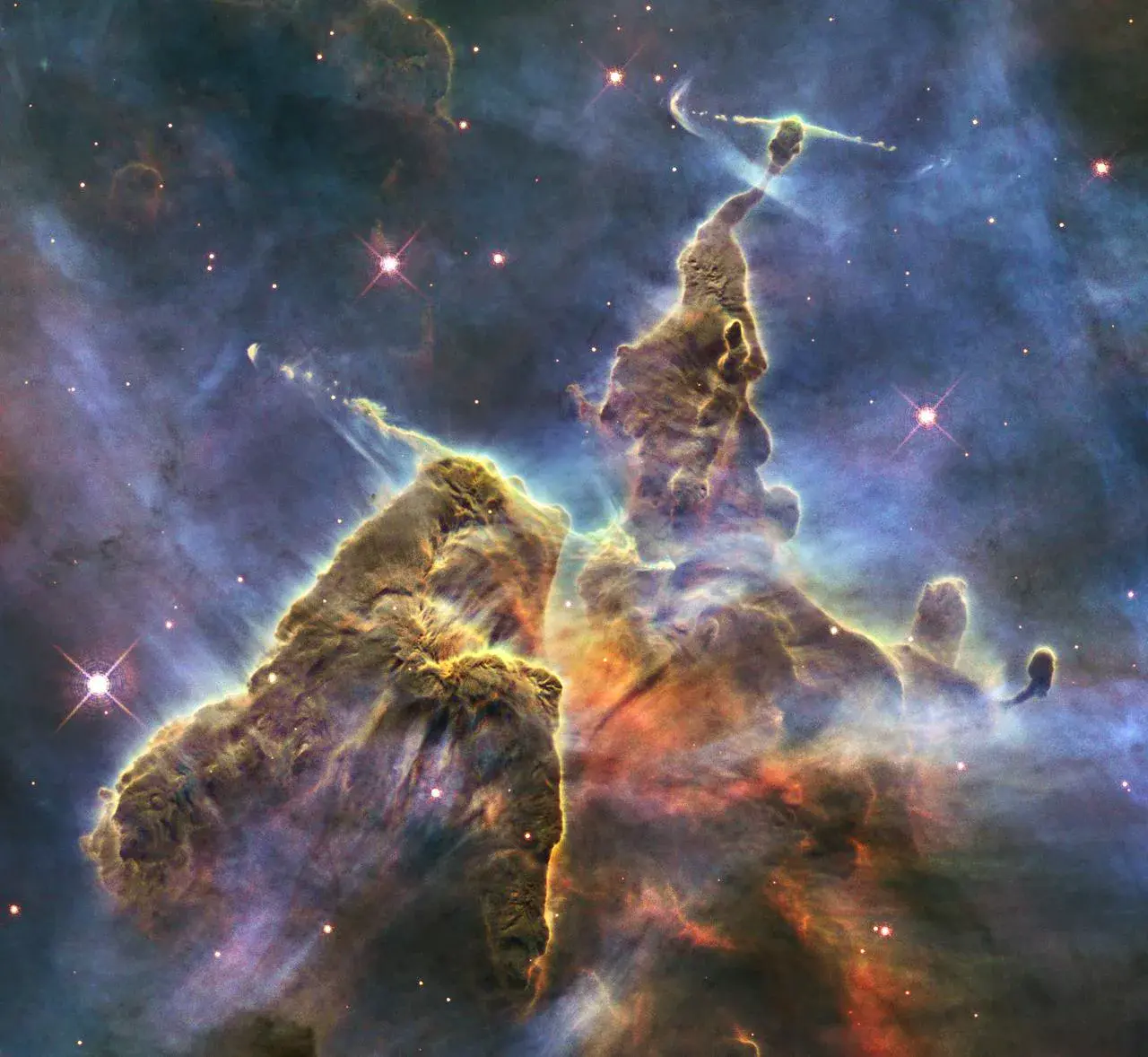
01 — Definition
What, exactly, is a galaxy?
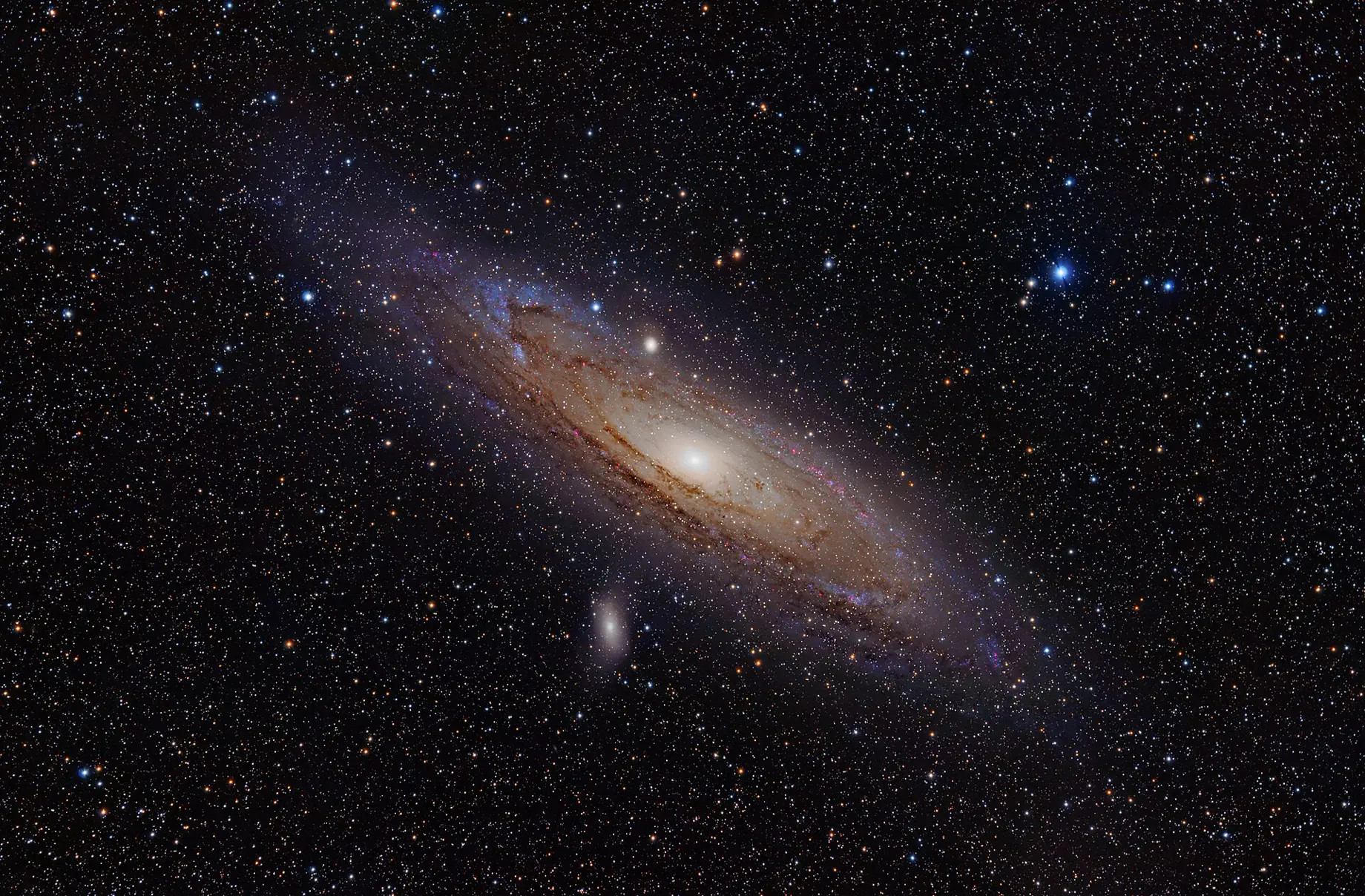
On any truly dark night you can see one with your naked eye. Look toward the constellation Andromeda and there is a faint, elongated smudge, easy to mistake for a wisp of cloud. That smudge is two and a half million light-years away, and it is not a cloud at all: it is roughly a trillion stars, seen all at once, so distant that they blur into a single glow. The light hitting your eye left it before our species existed. A galaxy is that — a vast, gravitationally bound city of stars, gas, dust and dark matter, adrift in space with unimaginable gulfs of emptiness between it and its neighbours.
The recipe varies enormously, but the ingredients are always the same. Stars supply the light — anywhere from a few million of them in the smallest dwarf galaxies to a hundred trillion in the largest giants. Between the stars drifts the interstellar medium of gas and dust, the raw material for future suns. And enclosing everything sits a huge, invisible halo of dark matter, which outweighs all the visible contents several times over and whose gravity holds the whole assembly together. The stars we see are, in a real sense, just the bright froth on something much larger and darker.
What is hardest to grasp is the emptiness of it all. Within a galaxy, stars are separated by light-years — if the Sun were a grape in Paris, the nearest star would be another grape in Warsaw. Yet galaxies themselves are packed surprisingly close together relative to their size: Andromeda lies only about twenty-five Milky Way diameters away. Stars almost never collide; galaxies collide all the time. That single fact, as we will see, drives much of how they grow and change.
"The history of astronomy is a history of receding horizons." — Edwin Hubble, who moved the horizon further than anyone: from one galaxy to billions.
02 — Origins
Where galaxies come from
Rewind 13.8 billion years and there are no galaxies — only a hot, nearly featureless fog of hydrogen and helium, expanding and cooling. The keyword is nearly. The infant universe carried tiny irregularities, regions a few parts in a hundred thousand denser than average, imprinted in its first instants. Gravity is patient. Over hundreds of millions of years those imperceptible ripples grew: the slightly denser regions pulled in material and became denser still, while the slightly emptier ones were drained. Every galaxy in the sky is the descendant of one of those primordial ripples.
Dark matter led the way. Feeling only gravity, it collapsed first into clumps and filaments — a scaffolding of invisible halos strung across the cosmos. Ordinary gas then fell into those ready-made gravitational wells, where it could do something dark matter cannot: radiate away its heat, sink, condense and ignite. The first stars flared perhaps within the first two hundred million years, and the first small, ragged galaxies assembled soon after. Galaxies did not form fully grown; they were built from the bottom up, small pieces merging into ever larger ones — a process that has never stopped.
Seeds in the fog
Density ripples of one part in 100,000, visible today as the mottling of the cosmic microwave background, were the seeds of every galaxy, cluster and void that exists.
Dark-matter cradles
Invisible halos collapsed first and provided the gravitational wells into which gas could pool. No dark matter, no galaxies — the visible universe hangs on the invisible one.
First light
JWST has now photographed galaxies whose light left them barely 300 million years after the Big Bang — smaller and brighter, surprisingly, than the models predicted.
03 — Structure
The anatomy of a galaxy
A big spiral galaxy like ours is not a homogeneous blob of stars; it is an engine with distinct working parts, each with its own population of stars, its own motion, and its own story. Working from the inside out:
One more component deserves mention because there is so much of it: the circumgalactic medium, an enormous atmosphere of thin, hot gas surrounding the whole galaxy. It is nearly invisible, yet it may hold as much ordinary matter as all the galaxy's stars together, and it is the reservoir from which the disc keeps drawing fresh fuel for star formation. A galaxy is less a finished object than a slow fountain — gas falling in, forming stars, being blasted back out by supernovae, cooling, and falling again.
04 — Classification
The shapes galaxies take
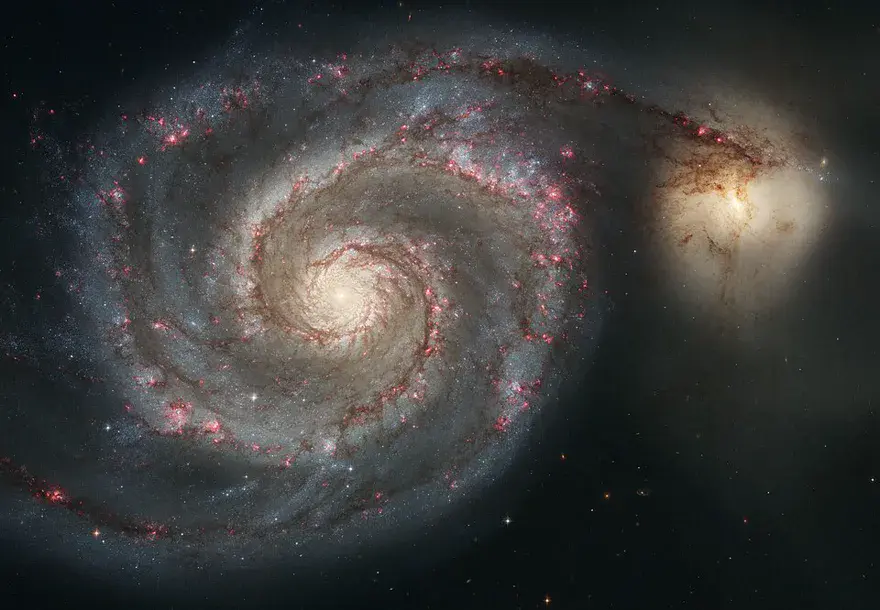
Edwin Hubble sorted galaxies by appearance into a scheme astronomers still use: a "tuning fork" running from smooth, featureless ellipticals through lens-shaped lenticulars to the grand spirals, with the shapeless irregulars off to one side. The labels are simple; the physics behind them — rotation, gas supply, and a galaxy's history of collisions — is anything but.
Spirals
Rotating discs rich in gas, still busily forming stars along their arms. Around six in ten bright galaxies near us are spirals, ranging from tightly wound to loose and ragged.
Ellipticals
Smooth, gas-poor swarms of old stars on randomised orbits — from dwarfs to the largest galaxies known. Many are the merged remains of spirals that collided long ago.
Lenticulars & irregulars
Lenticulars are discs that have run out of gas — spirals gone quiet. Irregulars are the misfits: small, chaotic, often shredded by the gravity of larger neighbours.
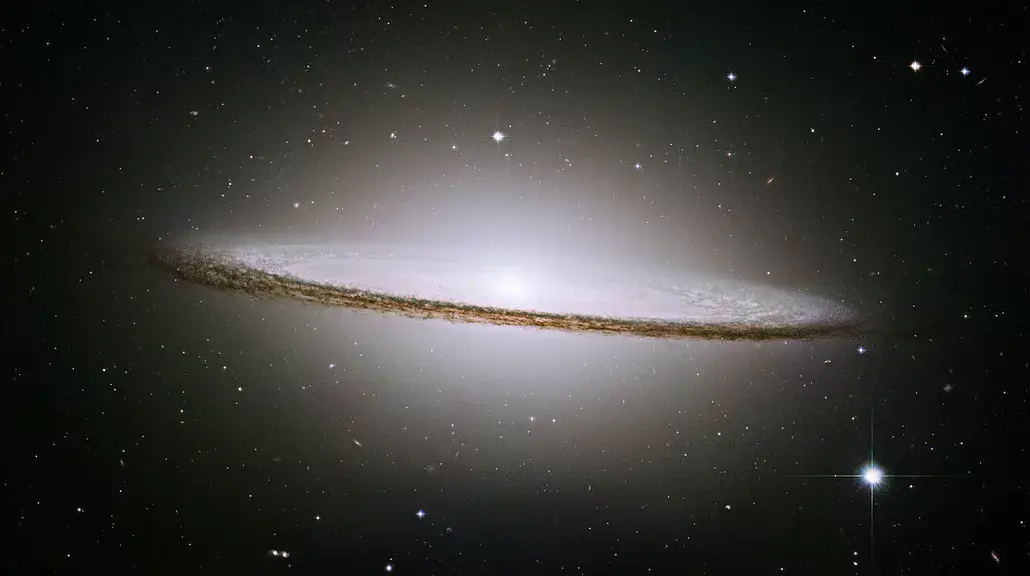
A hat that defies the labels
The Sombrero shows why classification is a starting point, not an answer. It has a spiral's dust-laned disc embedded in an elliptical's enormous glowing halo, and a central black hole of a billion solar masses. Nature did not read Hubble's diagram.
05 — Home
The Milky Way, seen from inside
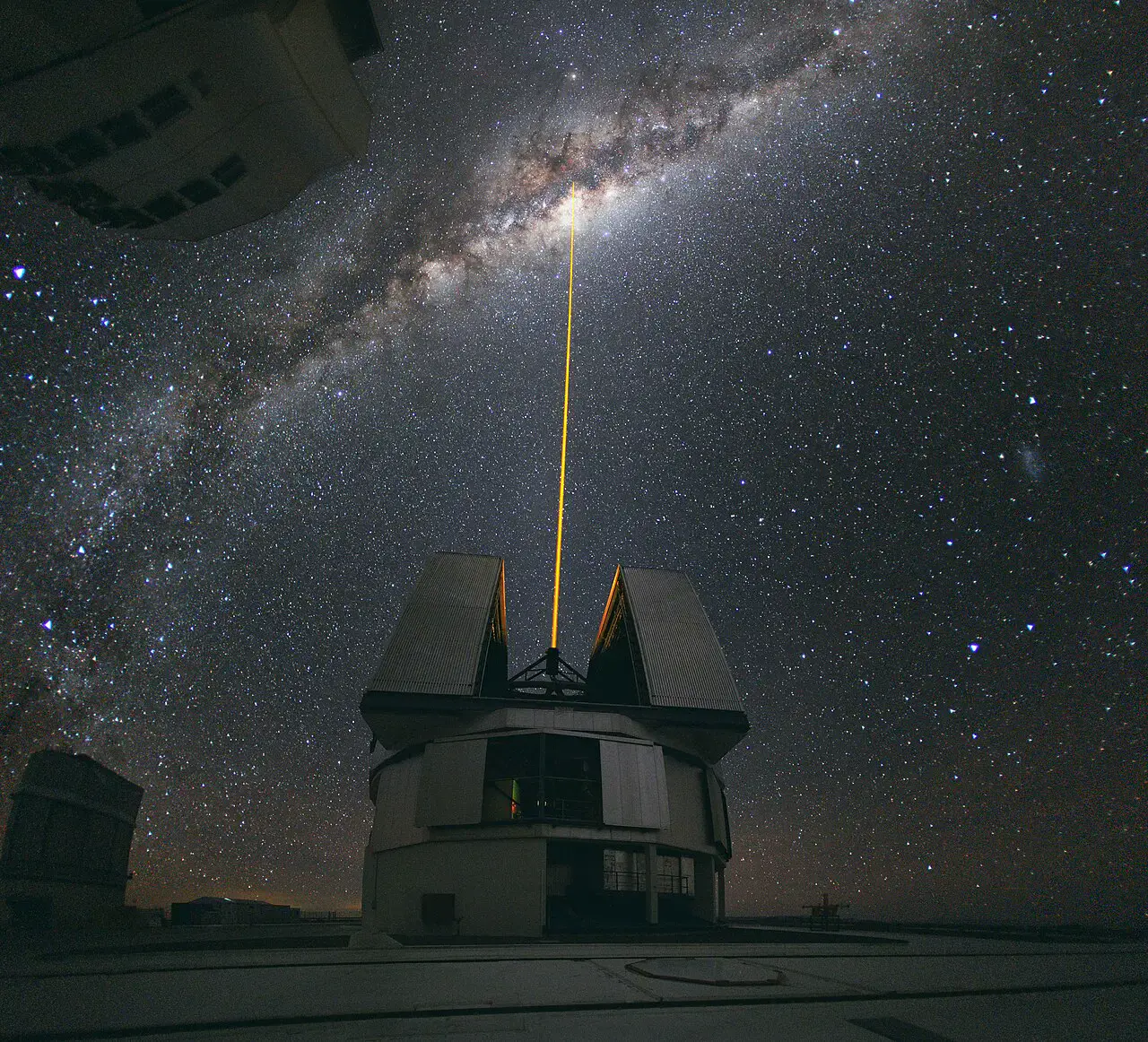
We live in a large barred spiral, about a hundred thousand light-years across, and we study it from a seat buried deep inside one of its arms — like mapping a forest without ever leaving one clearing. That pale band across the summer sky is the disc of our own galaxy viewed edge-on from within: the combined shine of billions of stars too distant to separate by eye. Every individual star you have ever seen at night belongs to it.
Home, by the numbers
The Sun sits about 26,000 light-years from the centre, orbiting at roughly 230 kilometres per second. One full circuit — a "galactic year" — takes so long that the last time we were here, dinosaurs were new.
The Milky Way is not alone. It anchors the Local Group, a gathering of some eighty-odd galaxies dominated by ourselves and Andromeda, trailed by swarms of dwarf satellites — several of which our galaxy is visibly in the process of tearing apart and absorbing. Streams of stars looping through the halo are the half-digested remains of past meals. Galactic cannibalism is not a colourful metaphor; it is the ordinary way big galaxies grow.
06 — Deep time
Collisions, and the view down the years
When two galaxies meet, almost no stars actually hit each other — the gulfs between them are too great. What collides is everything else: the gas clouds slam together and ignite firestorms of star formation, gravity flings long tails of stars into space, and over a billion years the two discs churn into a single, larger galaxy. Far from being catastrophes, collisions are the engine of galactic evolution — the mechanism that turned the small ragged fragments of the early universe into the giants of today.
Our turn is coming. Andromeda and the Milky Way are closing at about 110 kilometres per second, and in roughly four to five billion years the two will begin a slow-motion merger, ultimately settling into a single elliptical galaxy that astronomers have already nicknamed Milkomeda. The night sky of that era will be extraordinary. The Sun, by then in old age, will most likely be flung to a new orbit and carry on, untouched.
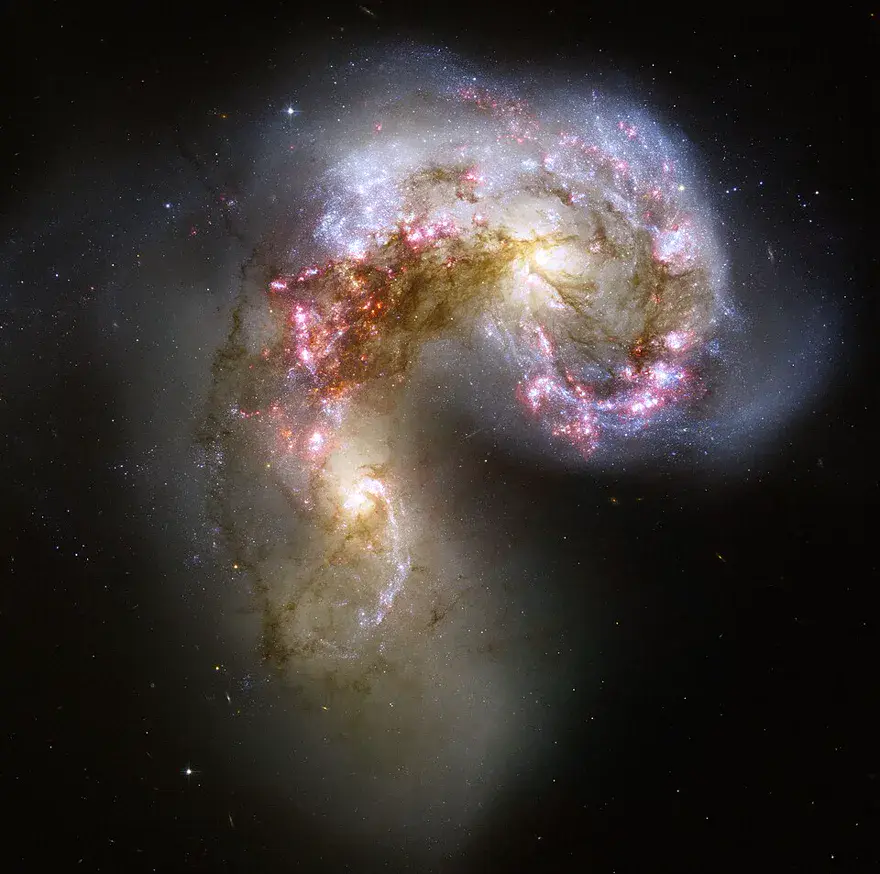
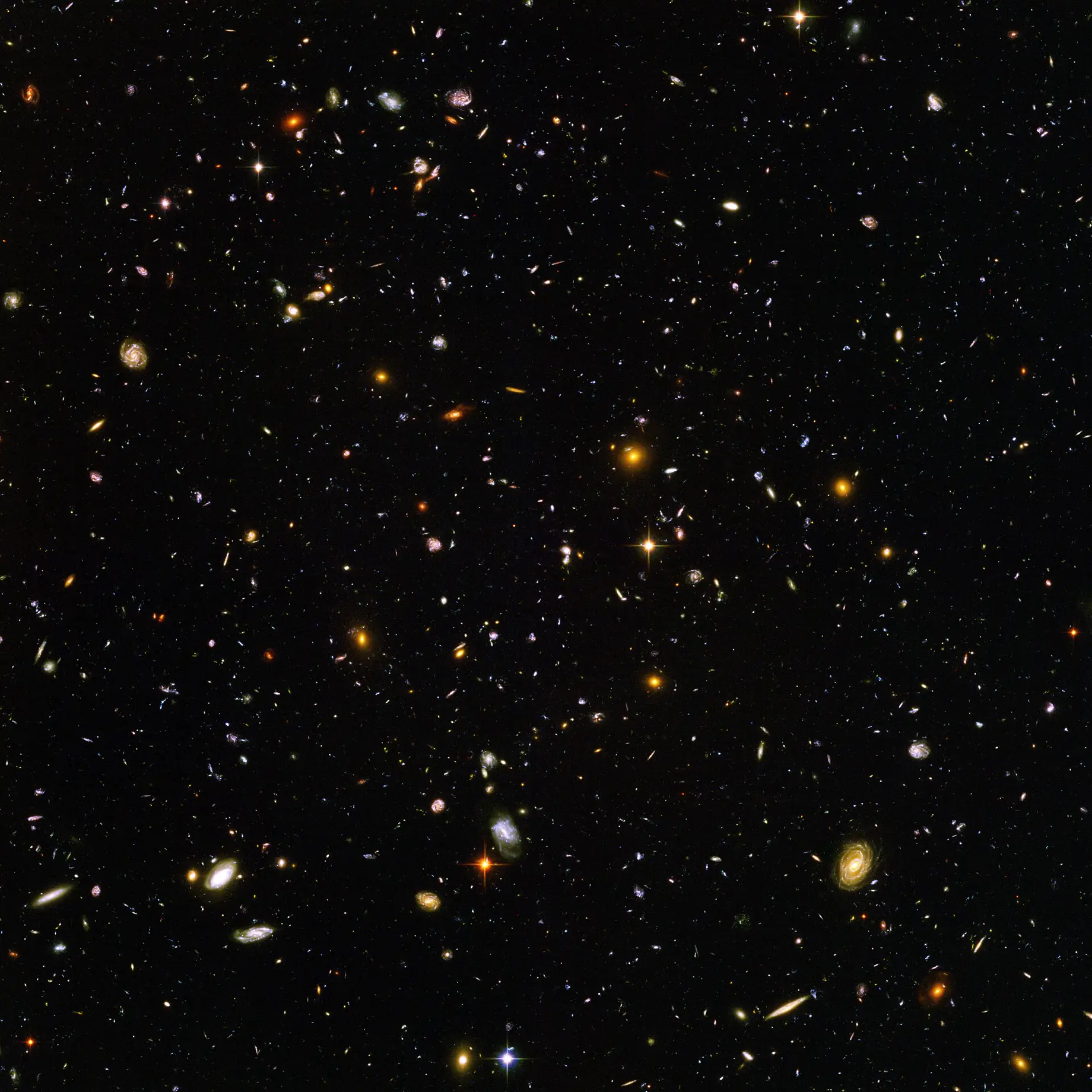
And because light takes time to travel, telescopes are time machines: point one at a patch of sky and the deeper you look, the further back you see. In 2004 Hubble stared at a speck of apparently empty sky, smaller than a grain of sand held at arm's length, for almost a million seconds. The image that came back contained about ten thousand galaxies, some seen as they were more than twelve billion years ago — the entire history of galaxy evolution, stacked in a single photograph.
07 — History
A short history of a large idea
- 964
A little cloud
The Persian astronomer al-Sufi records Andromeda as a "little cloud" — the first written note of another galaxy, a millennium before anyone could know what it was.
- 1755
Island universes
Immanuel Kant speculates that some nebulae are enormous, distant systems of stars — "island universes" — a philosophical guess that would take 170 years to confirm.
- 1920
The Great Debate
Astronomers Shapley and Curtis publicly argue whether the spiral nebulae lie inside our galaxy or far beyond it. The evidence, at that point, could not decide.
- 1924
Hubble settles it
Using Cepheid variable stars as distance markers, Edwin Hubble shows Andromeda lies far outside the Milky Way. The universe becomes, overnight, a universe of galaxies.
- 1929
Everything is receding
Hubble finds that the further away a galaxy is, the faster it recedes — the expansion of the universe, read directly from galaxy light.
- 1970s
The invisible majority
Vera Rubin's rotation measurements show galaxies spinning too fast for their visible mass — the first strong evidence that galaxies are wrapped in dark matter.
- 2004
The deepest look
The Hubble Ultra Deep Field reveals ten thousand galaxies in a blank patch of sky, tracing galactic history almost back to the beginning — a lineage JWST is now extending further still.
08 — Common questions
Questions people actually ask
09 — A closing thought
The century we found the universe
It is worth pausing on how recently all of this was unknown. When your great-grandparents were born, respectable astronomy held that the Milky Way was the entire universe, and the spiral nebulae were minor whirlpools of gas somewhere inside it. A single measurement — Hubble's Cepheid in Andromeda, in 1924 — multiplied the known universe by a factor of billions. There are people alive today who were born into a cosmos one galaxy wide.
Since then, every improvement in our instruments has revealed galaxies to be stranger and more interconnected than we thought: cannibalising one another, growing black holes at their hearts, strung along filaments of invisible matter, rushing apart on the expanding fabric of space. And still the deepest questions stay open. Why did the first galaxies light up so fast? Why do black holes and their host galaxies grow in lock-step? What, precisely, is the dark scaffolding they hang on?
A galaxy, in the end, is the unit of the cosmos — the place where matter gathers tightly enough to make stars, planets, chemistry and, at least once, astronomers. Every atom in your body heavier than helium was forged inside this one. We are not observers of the Milky Way; we are a part of it that recently opened its eyes.
One galaxy became two trillion.
A century ago we thought the Milky Way was everything. One measurement dissolved that horizon — and every deeper look since has found more islands of stars, further back in time, than anyone dared predict.